
Behavioral Health Billing: The 7 Most Expensive Denial Reasons (and How to Stop Them)
Behavioral health denial rates are often higher than general medical due to telehealth rules, prior authorizations, credentialing gaps, modifier errors, and payer-specific billing requirements. Learn the 7 most expensive denial reasons and the operational fixes that reduce denials, improve cash flow, and strengthen behavioral health revenue cycle performance.
BLOG
Ashfaq Ahmad
5/22/20263 min read
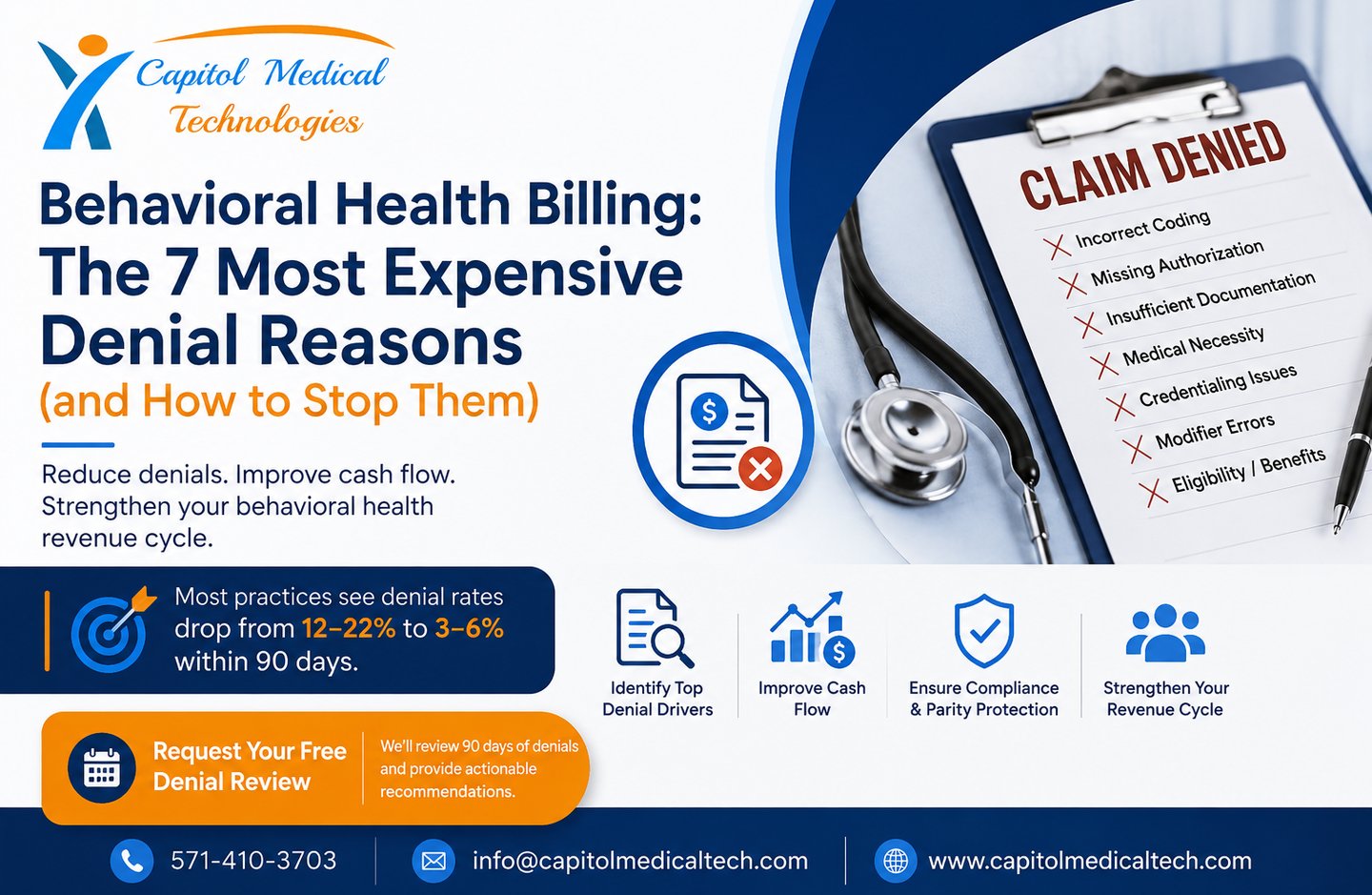
Behavioral Health Billing: The 7 Most Expensive Denial Reasons (and How to Stop Them)
Behavioral health denial rates often run between 12–22% at many practices — significantly higher than general medical specialties. Part of that comes from the complexity of behavioral health billing itself: parity-related disputes, evolving telehealth rules, prior authorization requirements, and payer carve-outs all create additional operational risk.
But another major issue is that many billing teams were trained in general medical billing environments and may not fully recognize the specialty-specific workflow failures that drive behavioral health denials.
Below are the seven denial categories that most commonly impact behavioral health revenue — and the operational fixes that help reduce them.
1. Incorrect CPT Code for Session Length
Behavioral health CPT coding is highly dependent on documented session time.
For example:
90832 → 30-minute psychotherapy
90834 → 45-minute psychotherapy
90837 → 60-minute psychotherapy
Each code has a specific allowable time range, and documentation must support the billed duration. If the session length does not align with the CPT code selected, the entire claim may deny.
Common operational failure:
Providers document vague session lengths or omit actual time spent.
Best practice:
Use documentation prompts that require:
Start time
End time
Total face-to-face minutes
Adding coder review before submission can also significantly reduce preventable denials.
2. Missing or Incorrect Add-On Codes
Behavioral health frequently uses add-on codes such as:
90785 — Interactive complexity
90840 — Crisis psychotherapy add-on
90863 — Pharmacologic management add-on
These codes can increase reimbursement appropriately, but they require very specific supporting documentation.
Common operational failure:
Practices either:
Underuse the codes and lose revenue, or
Apply them incorrectly without adequate documentation support.
Best practice:
Develop payer-aware documentation templates tied specifically to add-on code requirements and provide ongoing specialty-specific billing education for staff.
3. Telehealth POS and Modifier Errors
Behavioral health has one of the highest telehealth utilization rates in healthcare.
Unfortunately, telehealth billing rules continue to evolve across payers, particularly regarding:
POS 02 vs POS 10
Modifier 95
GT modifier usage
Audio-only requirements
State-specific behavioral health rules
Common operational failure:
Practices apply the same telehealth rules across all payers.
Best practice:
Maintain payer-specific telehealth billing playbooks that are reviewed and updated quarterly.
Behavioral health telehealth billing is not standardized enough to rely on “universal rules.”
4. Prior Authorization Not on File
Services such as:
Intensive Outpatient Programs (IOP)
Partial Hospitalization Programs (PHP)
Extended outpatient behavioral health treatment
often require prior authorization or concurrent review approval.
Common operational failure:
Authorizations expire mid-treatment or are not updated during ongoing care.
Best practice:
Implement authorization tracking systems with:
Expiration monitoring
Calendar-based renewal alerts
Concurrent review follow-up workflows
The most effective teams treat authorizations as active workflows, not one-time tasks.
5. Medical Necessity and Parity-Related Denials
Behavioral health claims are frequently denied for “medical necessity” at rates much higher than many medical specialties.
Under the Mental Health Parity and Addiction Equity Act (MHPAEA), certain behavioral health restrictions may violate parity protections — but practices must appeal appropriately and document thoroughly.
Common operational failure:
Practices accept denials without structured appeals.
Best practice:
Use parity-aware appeal templates that:
Cite payer medical necessity criteria directly
Identify inconsistent utilization management standards
Document comparable medical/surgical coverage differences when applicable
Strong appeals often require both clinical and operational coordination.
6. Credentialing Gaps and Lapses
Credentialing failures can quietly create massive revenue loss.
If a provider’s enrollment:
Expires
Lapses
Fails to renew
or becomes misaligned with payer records
claims may deny retroactively for weeks or months before anyone notices.
Common operational failure:
Credentialing is tracked manually or managed reactively.
Best practice:
Maintain:
90-day renewal monitoring
Centralized credentialing tracking
Payer roster audits
Dedicated credentialing ownership
Credentialing is not administrative overhead — it is revenue protection.
7. Subscriber ID and Behavioral Health Carve-Out Errors
Many behavioral health benefits are carved out separately through organizations such as:
Optum Behavioral Health
Magellan
Carelon/Beacon
payer-specific managed behavioral health vendors
The behavioral health payer may differ entirely from the medical payer.
Common operational failure:
Front-end staff verify only medical benefits.
Best practice:
Eligibility workflows should specifically verify:
Behavioral health payer entity
Carve-out requirements
Subscriber identifiers
Authorization pathways
Network participation
Failure at intake often becomes denial downstream.
What Happens When Practices Address All Seven?
Behavioral health practices that systematically address these denial categories often reduce denial rates from 12–22% down to approximately 3–6% within 90 days.
That improvement can translate into:
Faster cash flow
Lower AR aging
Reduced rework
Fewer write-offs
Improved staff efficiency
Stronger operating margins
The solution is rarely a single tool.
Sustainable improvement usually comes from:
Specialty-trained billing teams
Payer-specific operational workflows
Proactive credentialing management
Structured authorization processes
Parity-aware appeals
Continuous denial trend analysis
Need Help Identifying Your Highest-Cost Denials?
At Capitol Medical Technologies, we help behavioral health practices improve revenue cycle performance through specialty-focused billing and operational support.
We can review your recent denial patterns, identify the highest-cost workflow gaps, and provide actionable recommendations for improvement.
Request a Free Behavioral Health Denial Review
We’ll review 90 days of denials and provide:
Denial category analysis
Payer trend insights
Operational risk findings
Workflow improvement recommendations
📞 Phone: 571-410-3703
📧 Email: info@capitolmedicaltech.com
🌐 Website: www.capitolmedicaltech.com
Contact
Supporting Healthcare Practices with Reliable Revenue Cycle & Clinical Documentation Services
(571) 410-3703
© 2026. All rights reserved.
About Us |
Capitol Medical Technologies, LLC
45 Rockefeller Plaza
20th Fl # 391
New York, NY 10111
United States