
Behavioral Health Telehealth Billing in 2026: Medicare, Modifiers and POS Rules
Behavioral health telehealth billing rules shifted in 2026: audio-only coverage narrowed, in-person visit requirements loom, and payers split on modifiers and POS codes. A practical billing guide for therapy and psychiatry practices.
BLOG
Ashfaq
7/23/20263 min read

My post content
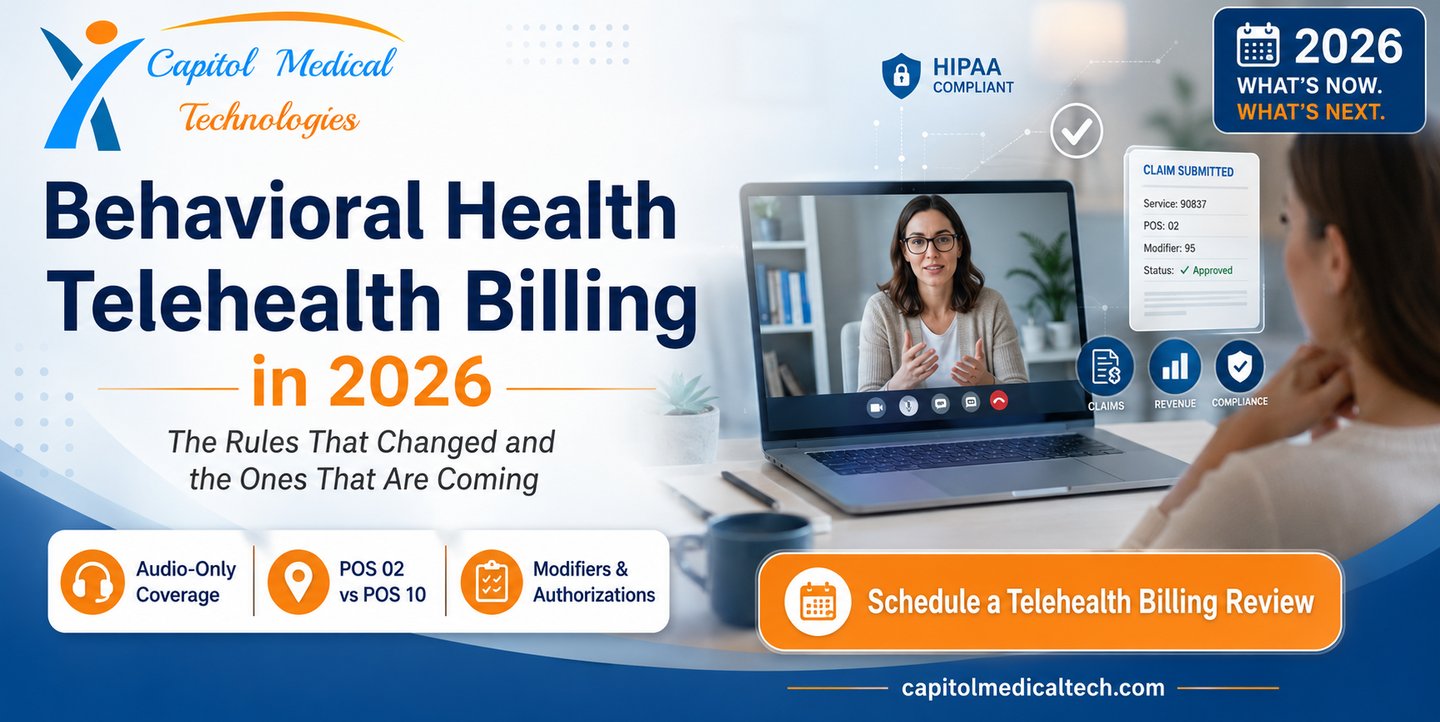
Behavioral Health Telehealth Billing in 2026: The Rules
That Changed and the Ones That Are Coming
No specialty depends on telehealth like behavioral health does. For many therapy and psychiatry practices, virtual visits are 50–90% of volume — which means telehealth billing rules aren't a compliance footnote. They're the revenue model. In 2026, those rules moved in three directions at once: Medicare stabilized, commercial payers
tightened, and a delayed in-person requirement continues to hang over the whole arrangement. Here's what behavioral health practices need to get right now.
Audio-Only: Medicare Yes, Commercial Increasingly No
Medicare continues to allow audio-only behavioral health services under specific conditions — including when the patient is unable or unwilling to use video. This matters enormously for older patients and for communities with limited broadband. Commercial payers have moved the other way. In 2026, most have narrowed audio-only coverage, and several now deny audio-only behavioral health sessions that would have paid in 2024. If a meaningful share of your sessions are phone-based, you need payer-by-payer confirmation of audio-only policy — and your documentation must state the modality and why video wasn't used, because that's the first thing an auditor checks.
The In-Person Requirement: Delayed, Not Dead
Under Medicare rules, patients receiving tele-mental health services are supposed to have an in-person visit within six months before their first telehealth appointment, and at least one in-person visit every 12 months thereafter. Congress has repeatedly delayed enforcement while extending broader telehealth flexibilities — currently through late 2027.
The strategic mistake is treating each delay as permanent. Virtual-first behavioral health practices should be building their answer now: a hybrid schedule, a partnership with a local practice for in-person visits, or a documented exception workflow. Practices that wait for enforcement to begin will lose Medicare patients they cannot legally serve.
Modifiers and Place of Service: Where the Denials Actually Happen
The most common behavioral health telehealth billing errors in 2026 are mechanical:
• Modifier 95 — synchronous audio-video telehealth. Some payers require it; others want POS codes alone.
• POS 02 vs POS 10 — telehealth delivered somewhere other than home vs the patient's home. Payers split on preference, and using the wrong one
triggers denials or facility-rate underpayments.
• Payer-specific quirks — some plans still want the older GT modifier; some Medicaid programs have their own matrix entirely.
Build a one-page telehealth billing grid for your top payers: required modifier, preferred POS, audio-only policy, and any frequency limits. Review it quarterly. This single document prevents more behavioral health denials than any software purchase.
Consent and Documentation
CMS requires documented patient consent for telehealth encounters. Verbal consent at the start of the session is fine — if it's recorded in the note. Beyond consent, payers auditing behavioral health telehealth claims look for three things: the modality documented (video vs audio-only, with reason), the time or MDM supporting the code level, and medical necessity for continued treatment. Thin notes are the leading audit exposure in behavioral health, and telehealth notes tend to be the thinnest.
Session-Based Authorizations Still Apply
Telehealth doesn't exempt you from behavioral health's authorization regime. Session-limited authorizations, expiring auths mid-treatment, and plan-specific visit caps all apply to virtual care exactly as they do in-office — and the new CMS prior authorization rule's 7-day decision deadline now gives you leverage when Medicare Advantage and Medicaid managed care plans sit on requests. Track remaining authorized sessions in your EHR and flag at three sessions remaining, not zero.
The Bottom Line
Medicare behavioral-health telehealth access is broadly protected through December 31, 2027, but that does not mean every claim will pay automatically. Audio-only requirements, modifiers, place-of-service codes, authorizations, documentation standards, state laws, and commercial payer policies still require careful review.
Practices should maintain a payer-specific telehealth matrix covering modality, modifier, place of service, authorization, frequency limits, and documentation requirements—and review it whenever a payer updates its policy.
Protect Your Behavioral Health Telehealth Revenue
Telehealth billing errors involving modifiers, place-of-service codes, authorizations, and payer-specific rules can lead to preventable denials and delayed payments.
Capitol Medical Technologies helps behavioral health practices manage telehealth billing, authorization tracking, denial resolution, payment posting, and payer-specific claim requirements.
Schedule a complimentary telehealth billing review today.
📞 571-410-3703
✉️ info@capitolmedicaltech.com
🌐 capitolmedicaltech.com
Contact
Supporting Healthcare Practices with Reliable Revenue Cycle & Clinical Documentation Services
(571) 410-3703
© 2026. All rights reserved.
Capitol Medical Technologies, LLC
45 Rockefeller Plaza
20th Fl # 391
New York, NY 10111
United States