
The New CMS Prior Authorization Rule Is Live: How Practices Can Hold Payers to Their Deadlines
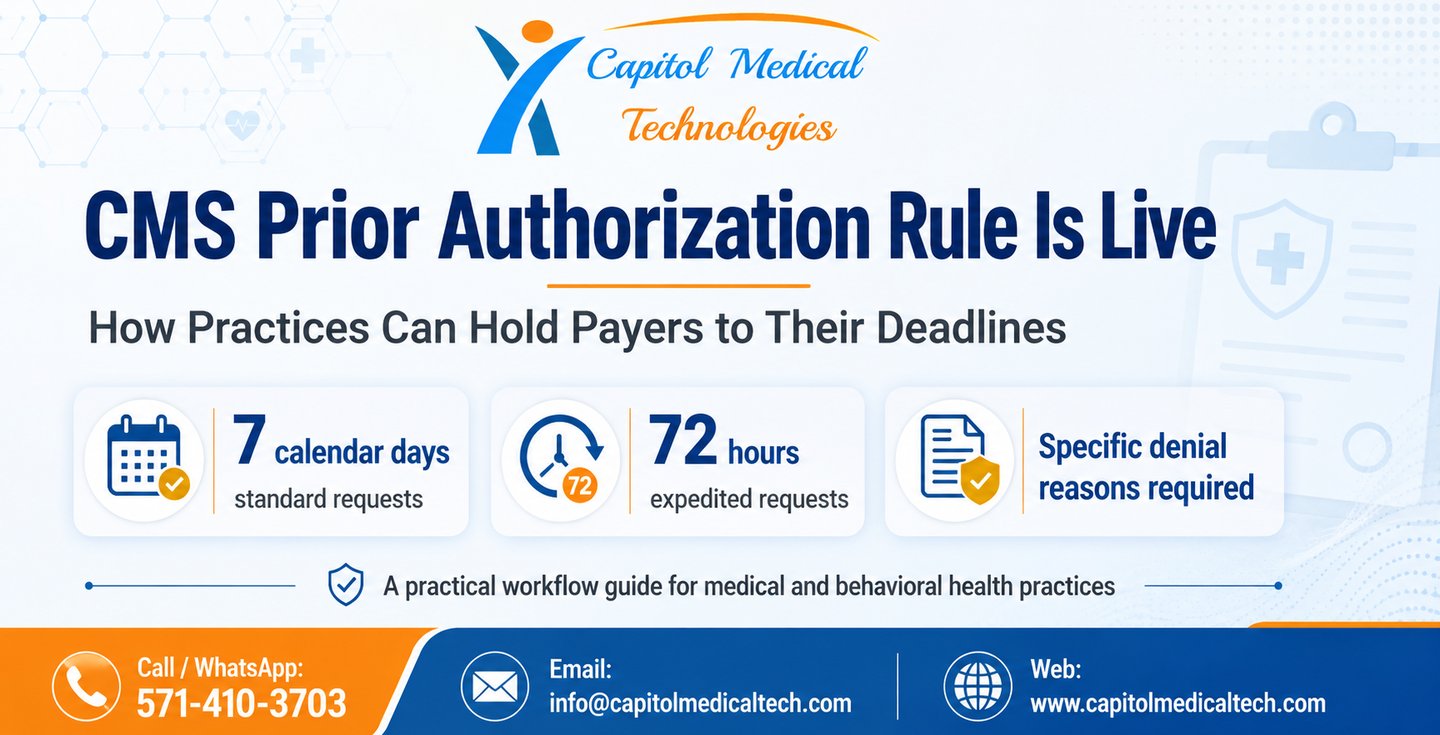
Blog post description.CMS-0057-F prior authorization requirements took effect January 1, 2026, requiring many payers to issue decisions within 7 calendar days, 72 hours for urgent requests, and provide specific denial reasons. Learn how practices can use the rule to improve prior authorization workflows.
BLOG
Ashfaq Ahmad
7/8/20264 min read
My post content
The New CMS Prior Authorization Rule Is Live: How Practices Can Hold Payers to Their Deadlines
For years, prior authorization has been one of the most frustrating parts of the revenue cycle.
Practices had deadlines. Payers often did not act like they did.
A practice that missed a filing deadline could lose revenue. A payer that delayed an authorization request could leave the patient waiting, the visit rescheduled, and the claim pushed into the next month or next quarter.
That imbalance is now changing.
CMS-0057-F, the CMS Interoperability and Prior Authorization Final Rule, includes operational prior authorization requirements that generally began January 1, 2026. The rule gives practices clearer payer expectations around decision timelines, denial reasons, and public reporting. CMS also states that several API-related requirements begin January 1, 2027.
For many practices, the rule is not just a compliance update. It is an operational opportunity.
The practices that benefit most will be the ones that change how they submit, track, escalate, and appeal prior authorizations.
What the Rule Requires
CMS-0057-F applies to Medicare Advantage organizations, state Medicaid and CHIP fee-for-service programs, Medicaid managed care plans, CHIP managed care entities, and Qualified Health Plan issuers on the Federally Facilitated Exchanges.
Under the operational prior authorization provisions, impacted payers, excluding QHP issuers on the Federally Facilitated Exchanges for the decision-timeframe requirement, must send prior authorization decisions within:
7 calendar days for standard requests
72 hours for expedited or urgent requests
CMS also requires impacted payers to provide a specific reason when a prior authorization request is denied, regardless of whether the request was sent through a portal, fax, email, mail, or phone. These provisions do not apply to prior authorization decisions for drugs.
CMS also requires impacted payers to publicly report certain prior authorization metrics annually on their websites, with the initial set of metrics due by March 31, 2026.
That matters because prior authorization is no longer only a back-office task. It is becoming a measurable payer-performance issue.
Why This Matters for Practices
The biggest mistake practices can make is treating the new rule as “payer news” instead of workflow news.
The 7-day clock only helps if your team knows when the request was submitted, what was included, which payer received it, and when the follow-up deadline hits.
If your staff batches prior authorization requests once or twice per week, the practice may be adding unnecessary delay before the payer’s clock even starts.
Daily submission should become the standard for practices with heavy authorization volume.
Specific denial reasons also change the way appeals should be handled.
In the past, many denial letters were vague. A practice might receive a denial that simply said the request did not meet criteria. That left the team guessing what to fix.
Now, when a payer gives a specific reason, the appeal should respond directly to that reason.
For example, if the denial says clinical documentation is missing failed conservative treatment, the appeal should not simply resubmit the same packet. The team should attach the exact documentation showing prior treatment, dates, outcomes, and why the requested service is medically necessary.
That is how one denial becomes one focused appeal instead of three rounds of rework.
Workflow Changes Practices Should Make Now
The first change is simple: track the clock on every authorization request.
Every request should have a logged submission date, payer name, submission method, confirmation number if available, standard or expedited status, and follow-up deadline.
For standard requests, set the follow-up alert at day 7. For urgent requests, set it at 72 hours.
If the payer misses the deadline, escalate clearly and professionally. Reference CMS-0057-F and document every call, portal message, and reference number.
The second change is to use expedited pathways correctly.
The 72-hour timeline is not for every case. It is for situations where the standard timeline could seriously jeopardize the patient’s health, life, or ability to regain maximum function.
Behavioral health crises, oncology care, pain management, post-acute needs, and certain specialty cases may qualify. Many practices underuse expedited review because the staff does not have clear criteria or a process for identifying urgent cases.
The third change is to build a denial-reason library.
Because payers must provide more specific denial reasons, your practice can now learn from patterns. After 60 to 90 days, you should know which payers deny for missing notes, failed therapy history, diagnosis mismatch, frequency limits, medical necessity language, or documentation gaps.
That data should feed directly into your authorization templates.
The goal is not just to appeal better. The goal is to submit better the first time.
The fourth change is ownership.
Prior authorization cannot be “whoever has time.”
Someone must own the request from submission to decision. That person should know what is pending, what is delayed, what was denied, what needs more information, and what is ready for appeal.
This owner can be in-house or outsourced, but the responsibility must be clear.
Final Takeaway
CMS-0057-F gives practices more leverage than they had before, but leverage only works when the workflow is organized.
The practices that win under this rule will not be the ones that simply know the deadline. They will be the ones that track every request, escalate when payers miss timelines, respond directly to denial reasons, and use denial data to improve the next submission.
Prior authorization is still not easy.
But in 2026, practices have a stronger framework to manage it.
The question is whether your team is using it.
Capitol Medical Technologies helps medical and behavioral health practices with prior authorization support, denial management, A/R follow-up, eligibility verification, credentialing, and billing workflow improvement.
What Practices Should Not Do
Practices should not assume that a missed payer deadline automatically means the service is approved. Unless a contract, state rule, or payer policy says otherwise, the safer approach is to escalate, document, and request a decision immediately.
Practices should also avoid sending the same documentation repeatedly without reading the denial reason. That only extends the cycle.
Finally, practices should not wait for software alone to solve the problem. Technology helps, but the real improvement comes from consistent submission, deadline tracking, denial analysis, and accountable follow-up.
Contact
Supporting Healthcare Practices with Reliable Revenue Cycle & Clinical Documentation Services
(571) 410-3703
© 2026. All rights reserved.
About Us |
Capitol Medical Technologies, LLC
45 Rockefeller Plaza
20th Fl # 391
New York, NY 10111
United States