
Eligibility Verification: The 3-Minute Task That Prevents More Denials Than Anything Else You Do
Eligibility and registration errors cause more claim denials than any coding issue. Learn the real-time verification workflow that catches coverage problems before the visit — and the 5 data points your front desk must confirm every time.
BLOG
Ashfaq Ahmad
7/11/20263 min read
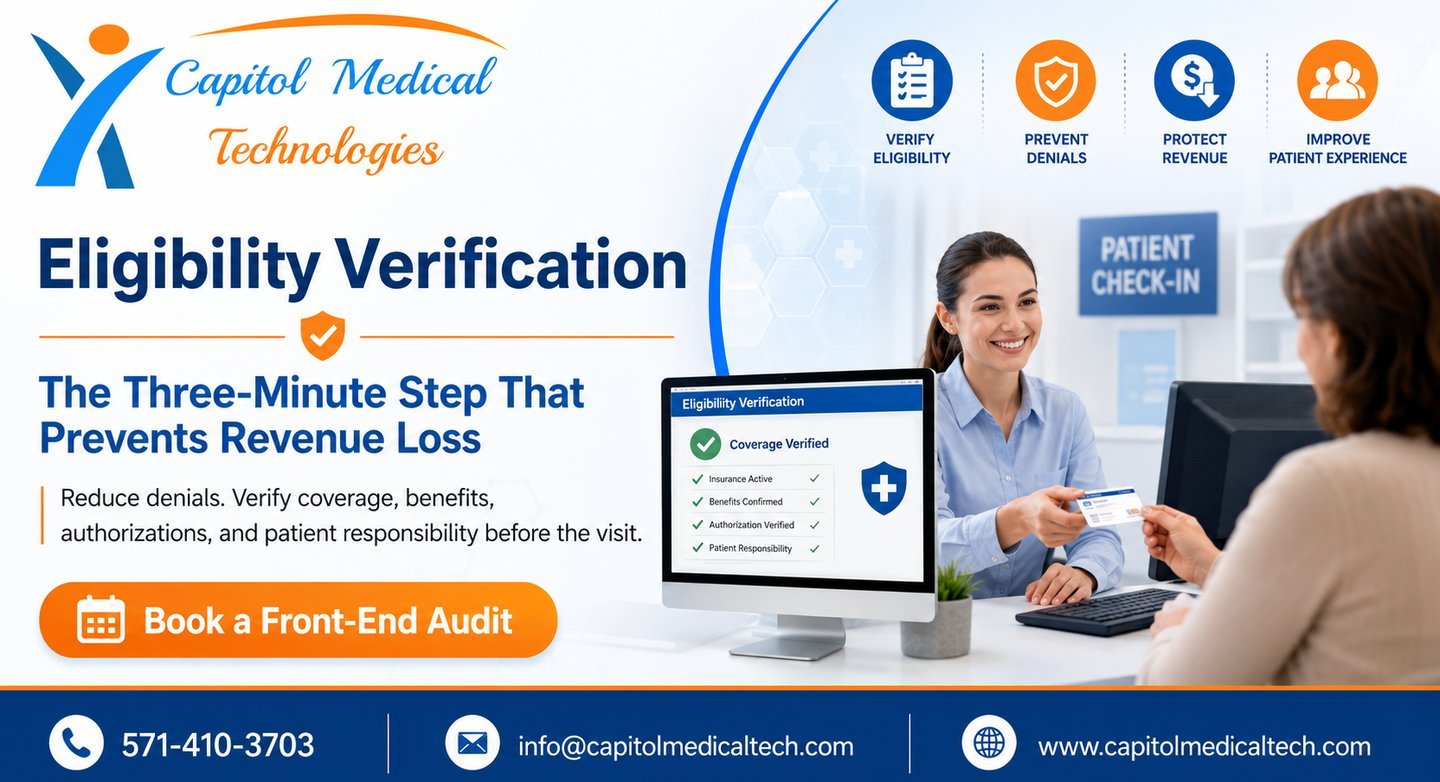
Eligibility Verification: The 3-Minute Task That Prevents
More Denials Than Anything Else You Do
Ask most practice owners where denials come from and they'll say coding. Ask the denial data and it says something different: the single largest category of preventable denials starts at registration — before a provider ever sees the patient, before a single code is selected.
Eligibility and registration errors consistently rank as the top denial driver across specialties. And unlike clinical denials, these are binary failures. The coverage was termed, or it wasn't. The plan required a referral, or it didn't. There is no gray area to appeal — which means the claim is usually a total loss unless someone catches it and rebills.
The fix is not more billing staff. It is a front-end verification workflow that runs before the visit, every time.
Why Eligibility Denials Are So Expensive
An eligibility denial doesn't just cost you the claim. It costs you the full cascade:
• The rework loop. Staff must identify the denial, contact the patient, find the correct coverage, update the record, and rebill — 30 to 45 minutes of labor per claim, against an industry average rework cost of roughly $25 per claim.
• The timely filing trap. By the time an eligibility denial surfaces and the correct payer is identified, you may be 60–90 days post-service. Miss the secondary payer's filing window and the revenue is gone permanently.
• The patient relationship. Nothing erodes patient trust faster than a bill for a visit they believed was covered, arriving months later. For a practice seeing 100 patients a week, even a 5% eligibility failure rate means five denied encounters weekly — often $500 to $1,500 in delayed or lost revenue, every week, from a problem
that takes three minutes per patient to prevent.
What "Verified" Actually Means
Most front desks believe they verify eligibility. What they usually do is confirm the insurance card on file hasn't changed. Real verification confirms five things:
1. Active coverage on the date of service — not the date of scheduling. Coverage terms mid-month constantly, especially with Medicaid redeterminations and employer plan changes.
2. The correct payer and plan. A patient can be "insured" but under a different product than the card shows — an HMO that requires referrals, a Medicare Advantage plan instead of traditional Medicare, or a plan where you're out of network.
3. Benefit specifics for the scheduled service. Does the plan cover the visit type? Telehealth? Behavioral health? Is there a visit limit, and how many remain?
4. Referral and authorization requirements. If the plan requires a referral you don't have, you want to know 48 hours before the visit — not 45 days after.
5. Patient responsibility. Copay, remaining deductible, and coinsurance — so you can collect at the time of service instead of chasing statements.
The Workflow That Works
High-performing practices run verification on a two-pass system:
Pass 1 — batch verification 48–72 hours before the visit. Run the full schedule through real-time eligibility. This surfaces termed coverage and referral gaps while there's still time to fix them — or reschedule. Flagged patients get a call before they walk in.
Pass 2 — day-of confirmation at check-in. Re-verify anything flagged, confirm demographic data character-by-character against the card (transposed digits in a member ID are a denial), and collect the known patient responsibility. The critical design principle: verification results must be actionable, not just recorded. A flag that nobody is assigned to resolve is the same as no flag.
Measure It Like Revenue Depends on It — Because It Does
Two numbers tell you whether your front end is working:
• Eligibility-related denial rate — denials with eligibility/registration reason codes as a share of total claims. Best-in-class practices keep this under 1%.
• Verification completion rate — percentage of visits verified before the patient arrived. Anything below 98% means the workflow has holes. Review both monthly. When eligibility denials spike, the cause is almost always a staffing gap, a new payer, or a scheduling channel (online booking, anyone?) that bypasses verification.
The Bottom Line
Eligibility verification is unglamorous, repetitive, and quietly one of the highest-ROI activities in your practice. Every denial it prevents is revenue that never had to be fought for.
Contact
Supporting Healthcare Practices with Reliable Revenue Cycle & Clinical Documentation Services
(571) 410-3703
© 2026. All rights reserved.
About Us |
Capitol Medical Technologies, LLC
45 Rockefeller Plaza
20th Fl # 391
New York, NY 10111
United States