
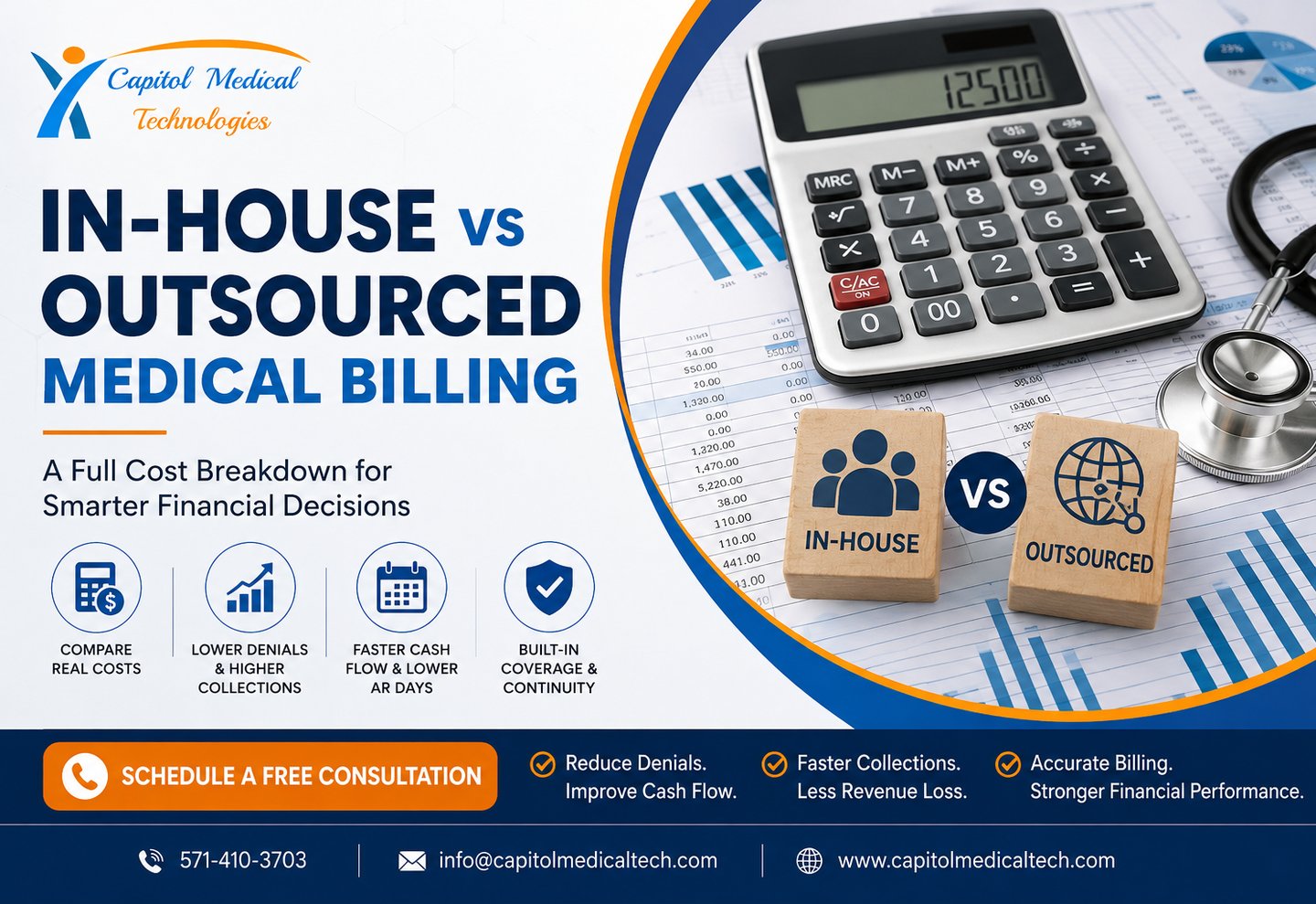
In-House vs Outsourced Medical Billing — A Full Cost Breakdown
Should your practice keep medical billing in-house or outsource it? Compare real costs, denial rates, AR performance, staffing, software expenses, and revenue impact in this complete breakdown from Capitol Medical Technologies.
BLOG
Ashfaq Ahmad
5/21/20263 min read
My post content
In-House vs Outsourced Medical Billing — A Full Cost Breakdown
Should You Keep Billing In-House or Outsource It?
Most practice owners revisit this question every few years — especially as the organization grows. But the decision is often based on comfort, familiarity, or a single bad experience rather than a true financial comparison.
The reality is that medical billing costs extend far beyond salaries alone.
To make a smart decision, practices need to evaluate:
staffing costs
software and infrastructure
denial rates
cash flow impact
operational continuity
long-term scalability
Here’s what the numbers actually look like.
The Real Cost of In-House Medical Billing
At first glance, in-house billing appears less expensive because costs are spread across multiple categories instead of arriving as a single invoice.
But once those costs are combined, the picture changes significantly.
Staffing Costs
A full-time medical biller in the United States typically costs between $55,000–$70,000 annually when salary, benefits, payroll taxes, PTO, and training are included.
An experienced Revenue Cycle Manager often costs:
$85,000–$120,000 annually
Most practices require approximately:
One biller per $2M in net collections
Plus management oversight
For a $5M practice, that usually means:
2.5–3 billing FTEs
Total staffing costs of roughly $180,000–$230,000 annually
Software and Infrastructure
Modern billing operations require far more than a practice management system alone.
Common recurring costs include:
clearinghouse fees
denial management platforms
eligibility verification tools
analytics and reporting software
payer portal management
secure communication systems
Typical annual cost:
$15,000–$40,000+
Training and Turnover
Medical billing turnover rates frequently exceed 25–35% annually.
Every replacement creates:
recruiting costs
onboarding expenses
productivity loss
temporary workflow instability
Replacing a single experienced biller can easily cost:
$5,000–$10,000 before full productivity returns
For a small in-house team, even one departure can disrupt the entire revenue cycle.
Coverage Gaps and Operational Risk
This is one of the most underestimated costs in healthcare billing.
When a key biller:
takes PTO
becomes sick
resigns unexpectedly
Claims often slow down immediately.
Many practices have little true redundancy built into their billing workflows.
For a $5M practice, even a short billing disruption can delay hundreds of thousands of dollars in claim submission and increase AR aging significantly.
Estimated Total In-House Cost
For a practice generating approximately $5M in annual collections:
Estimated yearly in-house billing cost:
$210,000–$295,000+
That equals roughly:
4.2%–5.9% of net collections
Smaller practices often experience even higher effective costs because software, supervision, and infrastructure expenses do not scale down proportionally.
The Real Cost of Outsourced Medical Billing
Outsourced billing is typically priced as a percentage of collections.
Most medical billing companies charge:
4%–8%
depending on:specialty complexity
claim volume
payer mix
service scope
For a $5M practice at 6%, annual outsourced billing costs would total approximately:
$300,000
At first glance, that may appear comparable — or even more expensive — than in-house billing.
But most comparisons overlook three major operational differences.
1. Lower Denial Rates
Specialty-focused outsourced billing teams often maintain denial rates between:
3%–5%
Many general in-house teams operate closer to:
10%–18%
That difference can represent:
hundreds of thousands of dollars in recovered revenue annually
For many practices, improved collections alone offset much of the outsourcing cost.
2. Faster Accounts Receivable Performance
Outsourced revenue cycle teams often maintain:
28–35 Days in AR
Many in-house operations average:
45–65 Days in AR
Improved cash flow impacts:
payroll stability
hiring flexibility
expansion planning
working capital availability
Especially for growing practices, cash timing matters.
3. Built-In Coverage and Continuity
One of the biggest advantages of outsourced billing is structural redundancy.
Billing operations continue even when:
staff members take leave
turnover occurs
workload spikes unexpectedly
Claims do not pause because a single employee is unavailable.
That operational continuity is difficult and expensive to replicate internally.
When In-House Billing Makes Sense
There are situations where in-house billing is absolutely the better option.
Very Large Practices
Practices exceeding:
$15M+ in annual collections
May achieve enough scale to justify a sophisticated internal revenue cycle department.
Highly Specialized Billing Structures
Some organizations have unique workflows involving:
Grant funding
Research billing
Unusual self-pay models
Highly customized payer structures
These may require specialized internal oversight.
Owner-Led Revenue Cycle Operations
A small number of practices maintain exceptional collection performance because the owner is deeply involved in billing oversight personally.
This is uncommon — but real.
The Decision Most Practices Actually Face
For most independent and group practices generating:
$1M–$10M annually
Outsourced medical billing often produces:
lower operational risk
stronger denial management
faster cash flow
more stable collections
improved scalability
The real decision is usually not about price alone.
It is about:
Trust
Visibility
Accountability
Communication
Operational continuity
That is why:
transparent KPI reporting
dedicated account management
denial visibility
specialty expertise
flexible contracts
Matter just as much as percentage rates.
Final Thoughts
There is no universal answer for every practice.
But there is almost always a measurable financial answer once:
Denial rates
Staffing instability
Software costs
AR performance
Operational continuity
Are included honestly in the comparison.
If you want to evaluate the true cost structure of your current billing operation, Capitol Medical Technologies can help you model the numbers using your own practice data.
Bring 12 months of billing performance data, and we’ll help you benchmark:
Denial trends
AR performance
Staffing efficiency
Total cost of ownership
Potential recovery opportunities
Without obligation.
📞 571-410-3703
📧 info@capitolmedicaltech.com
🌐 www.capitolmedicaltech.com
Contact
Supporting Healthcare Practices with Reliable Revenue Cycle & Clinical Documentation Services
(571) 410-3703
© 2026. All rights reserved.
About Us |
Capitol Medical Technologies, LLC
45 Rockefeller Plaza
20th Fl # 391
New York, NY 10111
United States